
Jemma Cotterell
Media Studies
G321 Foundation Portfolio
Friday 13th March 2015
Question 1:
In what ways does your media product use/ challenge the conventions in real media products?
Mise en Scene
the Mise en Scene of our thriller was very important, as it sets the scene. this was split into several areas.
Location
As part of Mise en scene, we decided on several different locations. This idea was inspired by Shutter Island, where the opening takes you through a number of locations that are seemingly unconnected. For instance, a car, a park and a living room are all incredibly normal places, yet not for a thriller film. These locations were used to add a normality and a realism to a characters (making them seem like every day people). The idea of realism is atypical of thriller films, as you can see from my thriller research; most follow a less naturalistic storyline. As they are unconventional, it creates an original storyline that we would exploit (by adding the supernatural into the real to create confusion) in the rest of the film. As it is not cliché it will create and interest in the audience as they won’t have seen a thriller like it. I think our choice of locations was successfully unconventional for a thriller.
However, we also chose a stereotypical wooded location for the end of our opening. We chose the location as it was a natural place, mixing with a supernatural murderess. Woods are quite typical, as seen in silence of the lambs. We chose them as they are an easy place to get lost in, or for someone to hide in. We wanted to show that our killer is in a desolate place, and is in essence, waiting for her next victim.


These are the woods at the beginning of Silence of the Lambs, from which we drew inspiration.
Lighting
We used lighting to contradict the conventions of normal thriller films. For example, in the last woods scene, the lighting is high key. This is unconventional, as most people associate scary woods as being dark. We decided to use light to create irony. We also used high key lighting in the park scene. This was inspired by 'the Shining', where the high key lighting seems unnatural, as it seems brighter than normal. As a thriller audience, our viewers will expect the unexpected, and will anticipate things going wrong, especially if something doesn’t seem quite right, so using high key lighting will create a sense of tension as they wait for the killer to appear. Although high key lighting was used in the opening of 'the Shining', it is not yet typical of the majority of thrillers, showing that we are defying conventions.
However, during the superimposition shots, we used the effects on Sony Vegas to lower the brightness and lower the image saturation. This makes the image darker, creating low key lighting. We did this to fit the conventions of dark colours representing death, showing that when our killer appears, our victims are doomed. Below you can see the two images side by side, showing that when the children are alive the image is slightly brighter.
The woods we used to keep our opening conventional.

The high key lighting in 'The Shining' is still rather uncommon, making our park scene unconventional.

 Park Scene Lighter | 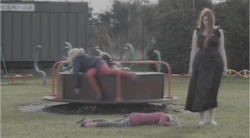 Park Scene Darker |
|---|
Costume
Another element of Mise en scene is costume. We chose to put our antagonist in a black gothic long dress, this is to connote death, as typically antagonists wear dark clothing to show that they are the evil side. We also chose a gothic dress because they are typical of the Victorian era, not modern day, making our killer seem out of time, making her seem even more supernatural. Click below to see our inspirations for our antagonists costume:
To keep with this theme, our children wore light bright colours, connoting liveliness. This creates shock when they get killed, as they were so innocent. We think this is effective is our thriller, as the shock of killing innocnet children heartlessly adds a horror edge to our thriller. you can see the childrens costume in the images above.
Click on the buttons below to go straight to a specific area of my evaluation.
Camera Work
In our camera work we have supported conventions. We have drawn inspiration from films such as se7en, in the fact we used close ups. Our first shot of the hand on the radio was chosen as you don’t know the victim, so it takes away their identity. This is useful as we are implying that the killer doesn’t know her victims particularly and is killing in cold blood. This makes our killer come across straight away as violet and merciless, as their victim is implied to be innocent. This also adds suspense, which is a typical thriller convention; as like in se7en you do not know who this person is. This creates a mystery as you want to know why they were killed. We wanted to emulate the suspense and mystery about why our first victim was killed without much thought. We think our first shot is successful in creating the mystery and suspense, using thriller conventions such as close-ups.
Our camera work also supports convention of the thriller genre in the use of hand held camera work to disorientate the viewer. Although the shot round the back of steph's head, showing her watch the TV, was intended to be smooth, after watching the footage back we agreed that the shakiness of the shot was almost reminiscent of the killers point of view, and was almost a predatory, stalker’s view. This shows that our killer is watching, even though in the following shot she is not there. This adds to the supernatural element of our killer. We think this shot is successful in disorientating the audience. To add to the confusion, we used a canted angle in the next shot, with the mug in focus rather than steph. This is so you wander why the mug is the main focus point, and then our killer appears over steph’s shoulder. We chose to use a focus pull so charlotte’s entrance is more unexpected. Our canted angle is typical, as it is used conventionally to show that showing isn’t right.


We took inspiration from Se7en, and used a close up shot for our opening shot, rather than an establishing shot. the close up gives the audience less information about the situation, opposed to a traditional establishing shot, which 'establishes' the scene. This shot created suspense in Se7en, and we believe creates suspense in our opening.


The victim and antagonist are not in focus for this shot, so when the victim dies it is more surprising.
This is the focus for this shot. The shallow depth of field will hopefully confuse the audience .
We used a canted angle in this shot to disorientate the viewer and signal that something is wrong.
Our camera work supports and challenges conventions in our last scene. we used a tripod to film this scene, which would conventionally be used to show normality, however as our supernatural killer is effectively 'coming for our audience', which is unsettling as it breaks the fourth wall between the veiwer and the action. We could have used a handheld shot to be more conventional. However, as we included a lot of superimposition, creating discontinuous editing, we neede our camera to be still to create the look of her moving backwards and fowards effectively.
Sound
Our backing track is conventional of thrillers. We chose the particular piece' Day of Chaos', by Kevin Macleod because it was royalty free, and fitted the style we desired. We decided that we wanted a piece that was suspenful, with a slower tempo, rather than something faster, as we believed this would create more tension and suspense, a key feature of thriller films. Here is a table of thre thriller openings I analysed for my research, showing whether the tempo was fast or slow:
As you can see, the most common tempo for thrillers is slow. This is why we chose Day of Chaos; we found that its slow tempo created suspense in the way we thought appropriate for our thriller. By using a piece with a slow tempo, we conformed to genre conventions.
Our sound effects were chosen to diegetically enhance key moments, to add a sense of distorted realism to our supernatural thriller. We chose to do this rather than keeping all diegetic sound in, as we found they would be to distracting from the camera work, but not take all of the sound out, as that would have made the sound track seem repetitve and unengaging. Using diegetic sound is rather unconventional, as it creates a more realistic feel, which could take away from the drama and suspense that thriller films create in their opening. All of the sound effects were put on afterwards, either created by us or found from royalty free sites on the internet, such as freesfx.com. We chose to recreate the sounds so that they sounded more disconnected from the action. for example, in a park, you wouldn't just hear laughter, but we decided the laughter as an important feature, and one that needed to be kept. By isolating it, it creates another supernatural dimension by creating a fake realism, which is unconventional for sound.
These are the openings I analysed, and all bar one use a non- diegetic soundtrack throughout. In 'Memento' diegetic sounds are used throughout with the soundtrack, which we drew inspiration from. However, we only put the sound effects in at specific moments, to one moment create realism, and take it away the next. This defies the genre convention, however we think it is effrective in creating suspense.
In our Soundtrack, we conformed to genre stereotypes by changing the music at pivotal points. To do this we layered two sound effects when the superimpositions occured. This was in response to our audience feedback, who said we should vary our soundtrack. Our sound effects were a fire crackling and an earthquake. We chose these spefically and the earthquake was low and bassy so contrasted and stood out against our main piece, Day of Chaos, and the fire because the crackling sound was reminiscent of something breaking, like something was going wrong, which was a feeling we wanted to create in our thriller.This was inspired partially by 'the Shining', where the low pitched soundtrack stands out at the start, and the change when the title appears, to a very high- pitched syntheser, showing that something unnatural is happening.

Friday 20th March 2015

Monday 23th March 2015
Editing
Our editing is unconventional, as we used a lot of discontinuous editing. Although this is found throughtout 'Se7en's opening, it is not used throughout most thriller openings. This teamed with extreme closeups creates a real sense of confusion in Se7en, so to emulate this we filmed scenes of our victims alive then scenes of the victim dead with our antagonist present, and used fast paced editing to create discontinous editing.
Our use of superimposition creats suspense as it confuses the audience, as they can't keep up with the action. this was influenced highly by Se7en, as their discontinous editing is highly confusing. We chose to do this as Thrillers are typically confusing, however it is uncommon in the opening, making our editing unconventional.
We used fast and slow paced editing, which supports the genre conventions. we did this to show a wider range of techniques, and to create a wider range of effects. For example, the first murder scene is completed in 7 seconds. We did this to confuse the audience, as a death so early on is uncommon. In the thrillers I analysed, the only other to show a death was 'Memento', and that death occurs slowly due to the slow paced editing. This shows that our thriller challenges the conventions of other thriller films. We also used fast paced editing in our superimposition shots swapping between the victims being alive and dead. We chose to make the superimpositions incredibly fast, so that the audience struggle to keep up with the action, and so are confused. This is a typical feature of thrillers, and is so seen in 'the Girl with the Dragon Tattoo' and 'Se7en' to name a few. This is because the audience are confused by the suddeness of the action they are seeing, making our editing conventional.
However, we also used slow paced editing to be conventional. Our main example of this is the last murder in the classroom. Whilst editing the footage we found it was the longest scene, which we cut down to 45 seconds in our final cut. However, this scene creates dramatic irony because we have already seen three murder scenes, so the audience are expecting another. By making this scene considerably longer than the rest we can create the suspense that is expected of a thriller film. Memento is a prime example of creating suspense, as the slow pace means the opening shot is around 1 minute long, which creates anticipation as you don't know what is happening. By using slower paced editing in this scene we created an irony, as the viewers realise that she will have to return for her keys, and she will probably be killed. This was shown when the character is packing up her school things, and the shot is 17 seconds long. This is conventional way to create suspense in thriller films.
In our opening we used fades to open each new scene. We did this to create a fly-on-the-wall effect, making the viewer feel like the events are actually someone’s life. The fades allowed us to do this as the action has started before the fade has finished, making it seem as if our character is half-way through doing something. This adds normality and realism to our characters, as it seems like they are going about their daily routine, which was something we wanted to achieve, so when our characters are murdered the audience sees them as real people rather than actors. This is found in 'Vertigo' and 'Black Swan'. In these openings it is used to show that these events are on going.


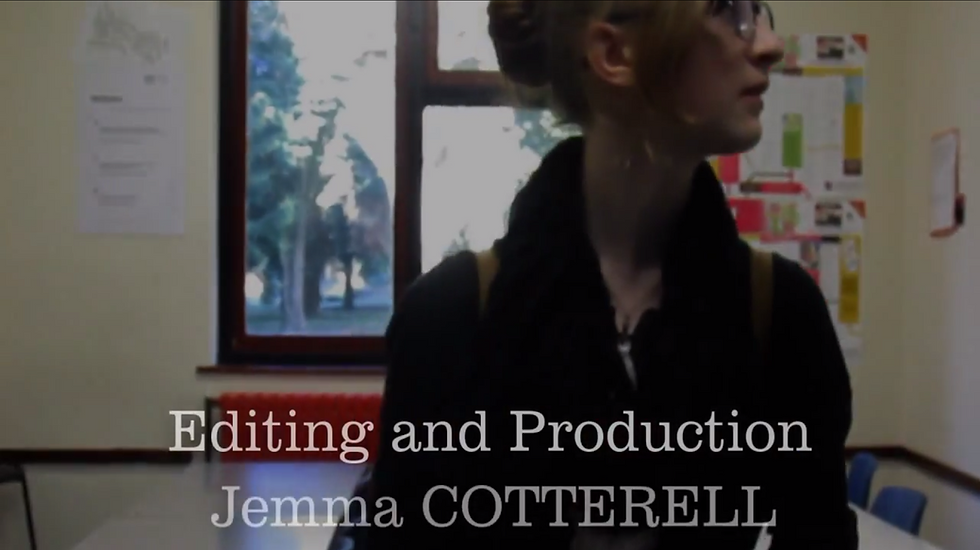


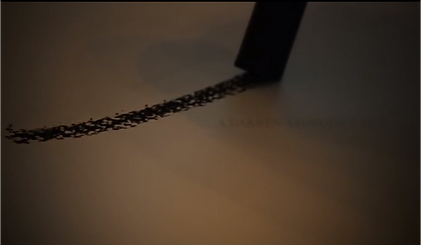
By fading the image in you create the illusion that these events are not just beginning, for example it seems like in ' Black Swan' she has been drawing for a while, and in 'Vertigo' this woman has been struck wherever she is for a long time. We used this in our four murder scenes to create the illusion that our first victim had already got in the car, our second had gone out of the room to make tea then come back, the kids had been in the park for a while and our student had been working for a long time. this is shown in the pictures below:


Using fades as above is typical of Thriller openings. To keep our transitions conventional, we only used straight cuts in the scenes. These are found throughout the openings of The Shining, Se7en and Memento. We used these as they are the most common type of transition, and made the action seem continous, as if in real time. We chose to use straight cuts purposefully rather than dissolves as they are conventionally used to show time passing, and transitions such as wipes didnt seem appropriate fr a thriller opening, as none of the openings my group or I anaylsed used them. as a result, we only use fades and straight cuts, which are conventional of the thriller genre.
Titles and Typography
In our Audience feedback, it was suggested that we could use a newspaper-style typeface for our text. This appealed to us, as in The Girl with the Dragon Tattoo there is two different typefaces used, one for the title and one for the credits. We drew inspiration from this and chose a font that looked like a typical newspaper font. To contrast this, we decided to use 'Viner Hand ICT' for the main title. The font we chose for the credits was inspired mainly by The Girl with the Dragon Tattoo and Black Swan. Those openings used a basic style font, with little animation. This was an inspiration for us, as the lack of movement meant the focus was on the action in the shot. As we have a busy opening we didn't want our text to distract from the camera work, so we used this text, making our typography conventional of thriller openings.
We chose Viner Hand ICT as a group before filming. We chose it because it looked hand written, and slightly old-fashioned, but not so much so it would look out of place. the text was mainly inspired by the Girl with the Dragon Tattoo, as we liked the way it looked like opening, and the way it was a mix between the edited style of the opening and the text. as a result, we used the effects on Sony Vegas Pro to add a 'Linear Blur' to the writing, to add an animated element to it. However, Viner Hand ICT was also chosen so it didn't look too similar to those in the openings we had analysed. This is because as an original media product it needs to be unique, to avoid cliche's. As a result, the Typeface is different to all those in the openings we analysed, making our title unconventional.
We chose white writing for all the text, to be conventional. the openings of Psycho, Se7en and Vertigo all use white for the credits in their openings. We liked this was it is basic, but still stood out against the colours in the film behind it. This makes our credits typical of the thriller convention.
We also gave 'The Shadow Concept' a red glow to make it stand out from the other writing in the opening to add importance. We also felt that the red was a good choice as red is used to connote danger, and blood. As you can see below, red writing is only used in the opening for Shutter Island, whereas white is used in Psycho, Se7en, Shutter Island, The Girl with the Dragon Tattoo and Vertigo, making it much more conventional of thriller films. This makes our titles and typography both typical and atypical of the thriller genre.





We used a similar text to The Girl with the Dragon Tattoo, as the simple styling is easy to read, meaning the audience have to focus on it too much, so they can focus on the camera work.

